Key takeaways
- Trails load your legs in ways road running doesn't: descents hammer your quads and climbs your calves.
- Two 20–30 minute sessions a week are enough, and you only need a step and a backpack.
- Pick exercises by where you fail first: the table below matches symptoms to exercises.
- Slow lowering (eccentric) work is the key for downhill strength.
- Sharp or growing pain is not a strength problem: see a physiotherapist.
01Why trail runners need strength
On the road every stride is similar. On a trail, you climb, brake on descents, land on uneven ground and twist around rocks. Descents are the hardest part: your quads work as brakes while they lengthen, which is the kind of effort that causes the deep soreness you feel for days.
Strength work prepares your muscles and tendons for those loads. It is one of the most consistent recommendations for runners who want to stay injury-free, and it is what lets you keep your form in the last hour of a long run.
02How to fit it in
When
- Twice a week, 20–30 minutes.
- On rest days or after an easy run, never right before a long run or a race.
- Keep at least one easy day between a strength session and your long run.
What you need
- A step or a stair, a wall, and a backpack.
- Add water bottles or books to the backpack when body weight gets easy.
- Dumbbells are a bonus, not a requirement.
03Find your weak spot
Start with what fails first on your runs. Every routine below works the whole leg, but give extra sets to the exercises for your weak spot.
| What happens | What it usually means | Focus on |
|---|---|---|
| Quads burn or ache on descents | Quads not used to braking | Slow step-downs, split squats |
| Calves or Achilles tight on climbs | Calves and tendons not used to steep ground | Calf raises, straight and bent knee |
| You roll your ankles | Ankle stability and balance | Single-leg balance, single-leg deadlift |
| Front of the knee aches on long descents | Hip and quad control | Slow step-downs, glute bridges, side plank |
| Hips and lower back tire late in the run | Core and hip endurance | Side plank, dead bug, glute bridges |
04Routine A: legs (20 minutes)
Do 2–3 rounds, resting about a minute between rounds. Move slowly and with control: the slow lowering is where the work happens.
- 1
Slow step-downs — 3 × 8 per leg
Stand on a step on one leg and lower the other heel to the floor in 3 seconds, keeping the knee over your toes. The best exercise for sore quads on descents.
- 2
Split squats — 3 × 10 per leg
One foot forward, one back. Lower your back knee towards the floor in 2–3 seconds and push back up. Builds the climbing muscles.
- 3
Calf raises — 3 × 15, straight then bent knee
On a step, rise onto your toes and lower below the step in 3 seconds. Do a set with straight knees and one with bent knees to work both calf muscles.
- 4
Glute bridges — 3 × 12
Lying on your back, push your hips up and squeeze for a second. Later, do them on one leg.
05Routine B: stability and core (20 minutes)
- 1
Single-leg balance — 3 × 30 s per leg
Stand on one leg with a soft knee. When it gets easy, close your eyes or stand on a cushion.
- 2
Single-leg deadlift — 3 × 8 per leg
Balance on one leg and hinge forward with a straight back until you feel the back of the leg, then stand up. Works hamstrings, glutes and ankles together.
- 3
Side plank — 3 × 30 s per side
Keeps your hips level when you are tired, which is when knees and ankles get hurt.
- 4
Dead bug — 3 × 10 per side
On your back, arms and knees up. Lower the opposite arm and leg without arching your lower back.
068-week progression
| Weeks | How | Example |
|---|---|---|
| 1–2 | Body weight, learn the movements | 2 rounds, slow and controlled |
| 3–4 | Add a round | 3 rounds |
| 5–6 | Add load | Backpack with 3–5 kg for step-downs, split squats and calf raises |
| 7–8 | Slower and harder | 4-second lowering, or single-leg versions of bridges and calf raises |
07Make your legs downhill-proof
Strength in the gym is only half of it: your legs also need to get used to descents themselves. Add short downhills to your runs and build them up the same way you build distance.
- 1
Start short
A few downhill sections of 1–2 minutes at an easy pace in one run a week.
- 2
Build gradually
Add a little more descent each week, not more than your legs recover from in a day or two.
- 3
Keep the technique
Short, quick steps, feet under your body, eyes 3–4 metres ahead.
08Help from your gear
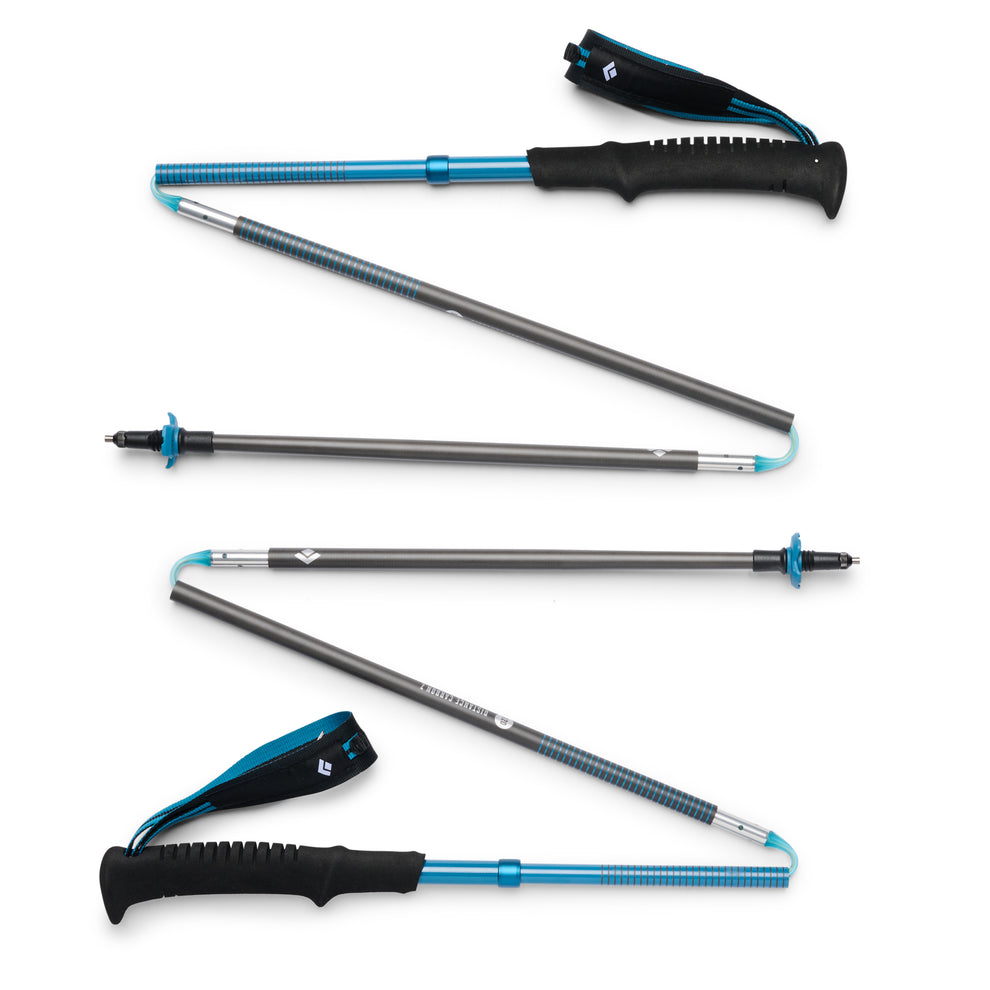
Poles don't replace strength, but on long, steep climbs they share the work with your arms and save your legs for the descents.
Trail running poles
Frequently asked questions
Should I do strength before or after running?
After an easy run, or on a separate day. Avoid it right before a hard session or a long run, when you want fresh legs.
Will strength training make me heavier or slower?
No. Two short sessions a week build strength and resilience without adding much muscle, and stronger legs hold their form better late in a run.
How long until I notice a difference?
Most runners feel less soreness after descents within 4–6 weeks of regular sessions. Strength keeps building for months.
Do the elliptical or the bike count as strength?
They are great for building aerobic fitness with less impact, but they don't load your muscles the way descents do. Use them on top of strength work, not instead of it.
Can I do it every day?
There is no need. Two or three sessions a week with rest in between give your muscles time to adapt.